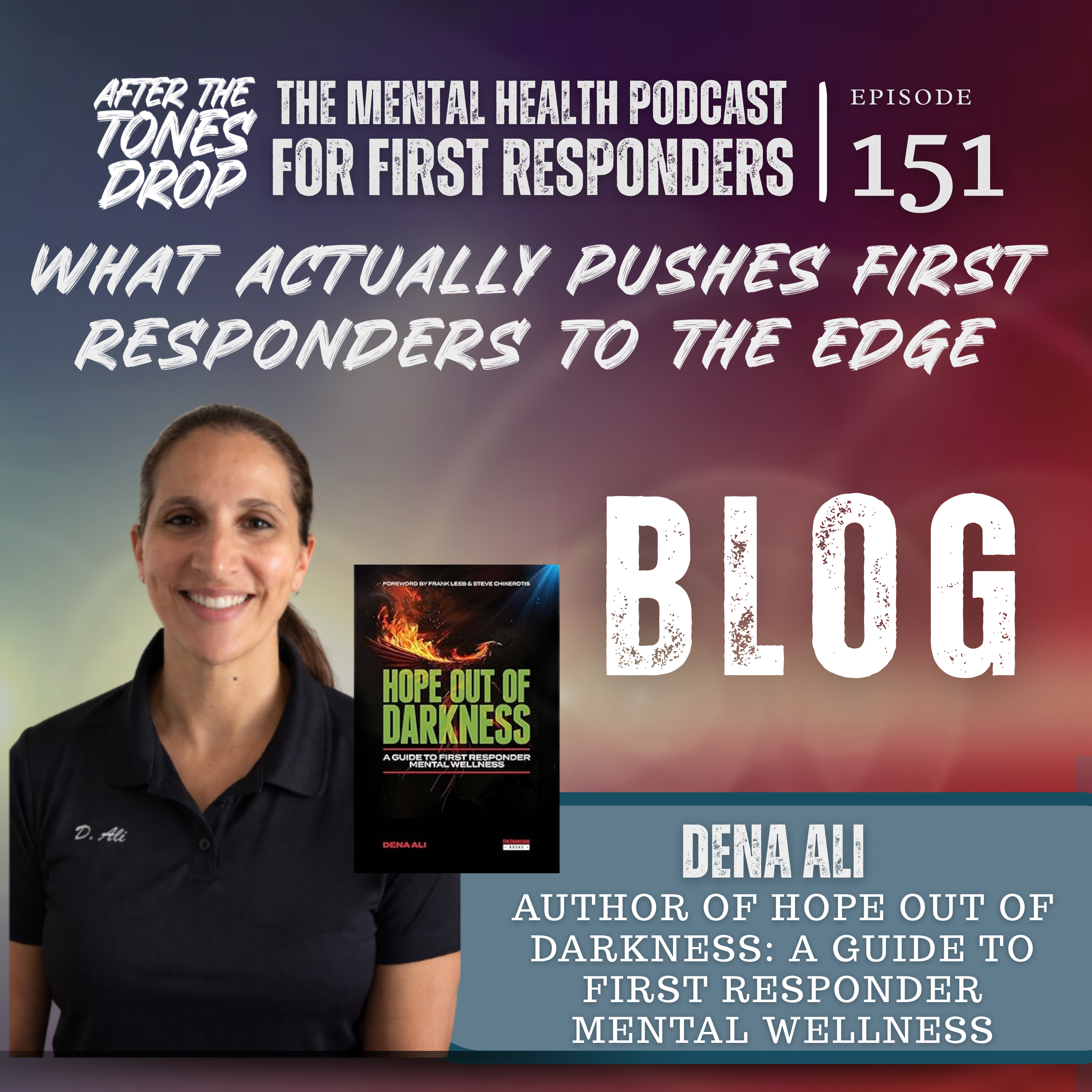
What Actually Pushes First Responders to the Edge
It’s Not Just the Calls...
There is a version of the first responder mental health conversation that is easy to understand, easy to repeat, and incomplete.
It usually sounds like this: somebody saw something awful, it wrecked them, and now they are struggling.
That version is not always wrong. It's just not the whole story.
In my conversation with Dena Ali on Episode 151 of After the Tones Drop, we talked about something the first responder world still has a hard time admitting. A lot of the pain that drives people to the edge is not just what they see on calls. It is what happens around those calls. It is the secrecy. The shame. The bullying. The culture. The feeling that if you tell the truth about what is going on inside of you, you will lose standing, respect, or belonging.
That is the angle I want to stay with here because Dena said something that matters. We are still trying to pin too much of this on one incident, one tragedy, one hard scene, when the reality is usually much more cumulative and much more personal.
It’s not just trauma. It’s what happens when you carry it alone.
Dena started doing this work at a time when firefighter suicide was still deeply taboo. She was researching it while privately going through a hard season herself. She printed articles face down in the firehouse because she did not want anyone to know what she was reading, especially because she was already struggling in her own mind.
That detail matters. Even someone drawn to the work, someone actively researching suicide prevention, still felt the need to hide what she was carrying. That tells you something about the culture.
A lot of first responders do not just carry trauma. They carry trauma in isolation. They carry it while trying to prove themselves. They carry it while acting like they are fine. They carry it in organizations where asking for help still feels risky.
That is why “just talk to somebody” is not enough. People talk when they believe it is safe to talk. People open up when they believe they will still belong afterward.
Belonging is not soft. It is survival.
One of the most important parts of this conversation was when Dena talked about bullying, harassment, and not fitting in. She said that chapter of her book was hard to write because it made her feel vulnerable, and because for a long time she did not want people to think she was not cool. That is real.
A lot of first responder mental health discussions stay focused on the dramatic stuff. The fatal fire. The bad wreck. The child death. Those matter. Of course they do.
But Dena makes a point that deserves more air time. The daily culture of not fitting in, being talked about, feeling left out, being made to feel like an outsider, or working in an environment where mistakes are punished instead of understood can do serious damage over time.
We do not talk enough about how painful it is to feel unsafe in the very place that is supposed to be your family.
And that is why belonging is not some soft leadership concept. It is a protective factor. It is one of the things that can keep people alive.
Peer support is not a substitute for caring culture
Dena has done enough peer support work to say something that some people will not like. A peer support team alone is not enough. In fact, if departments are not careful, peer support becomes the scapegoat. The excuse. The place leaders send people so they do not have to deal with feelings themselves.
That is not support. That is outsourcing humanity.
She said something I loved. She would rather get rid of the peer support team altogether if the whole organization could simply learn how to listen, how to care, and how to let people have bad days without shame.
That is the dream, right?
Not a handful of trained people carrying the whole emotional load of an agency while everyone else stays detached. Not supervisors calling the peer team instead of talking directly to their own people. Not a culture where vulnerability gets redirected to “the right person” instead of received with care.
The goal is a workplace where people actually know how to show up for each other.
A workplace where the response is not “go talk to peer support” but “I’m glad you told me. What do you need?” That is the kind of sentence that changes things.
Creating Cultures Where People Feel Safe
This episode asks a harder question than “what more do we need to do?”
It asks whether we are willing to become the kind of people and the kind of organizations where support feels natural instead of specialized.
Dena is not dismissing peer support. She built it. She knows how valuable it is.
But she is also telling the truth. The long game is not just training more peer supporters. The long game is creating cultures where people feel safe enough to speak before they hit the breaking point.
That takes leadership, it takes boudaries, and curiosity over judgment.
It takes people caring enough to notice who is not fitting in and not walking past it.
If you care about first responder mental health, this episode is worth your time. And if you lead people, it is worth even more.
Access the book Dena Ali wrote here 👇
Hope Out of Darkness: A Guide to First Responder Mental Wellness
Listen to the full conversation with Dena Ali here: https://www.afterthetonesdrop.co/dena-ali

Host
Cinnamon has spent over 25 years in the trenches of trauma work—but for the last eight, she’s been all-in with one mission: making sure the people who run toward chaos have somewhere to land when the dust settles.
She’s a trauma therapist, a trainer, and a national speaker on first responder mental health. From firehouses to squad rooms to conference stages, she shows up with honesty, respect, and the tools to help responders move from surviving to actually living.
And here? She’s your host.
After the Tones Drop is her raw, unfiltered podcast built for the first responder community. Because staying alive isn’t enough. Her work is about reclaiming life—on your terms.
The Firefighter Behind the Gear: Why Wellness Is a Readiness Issue