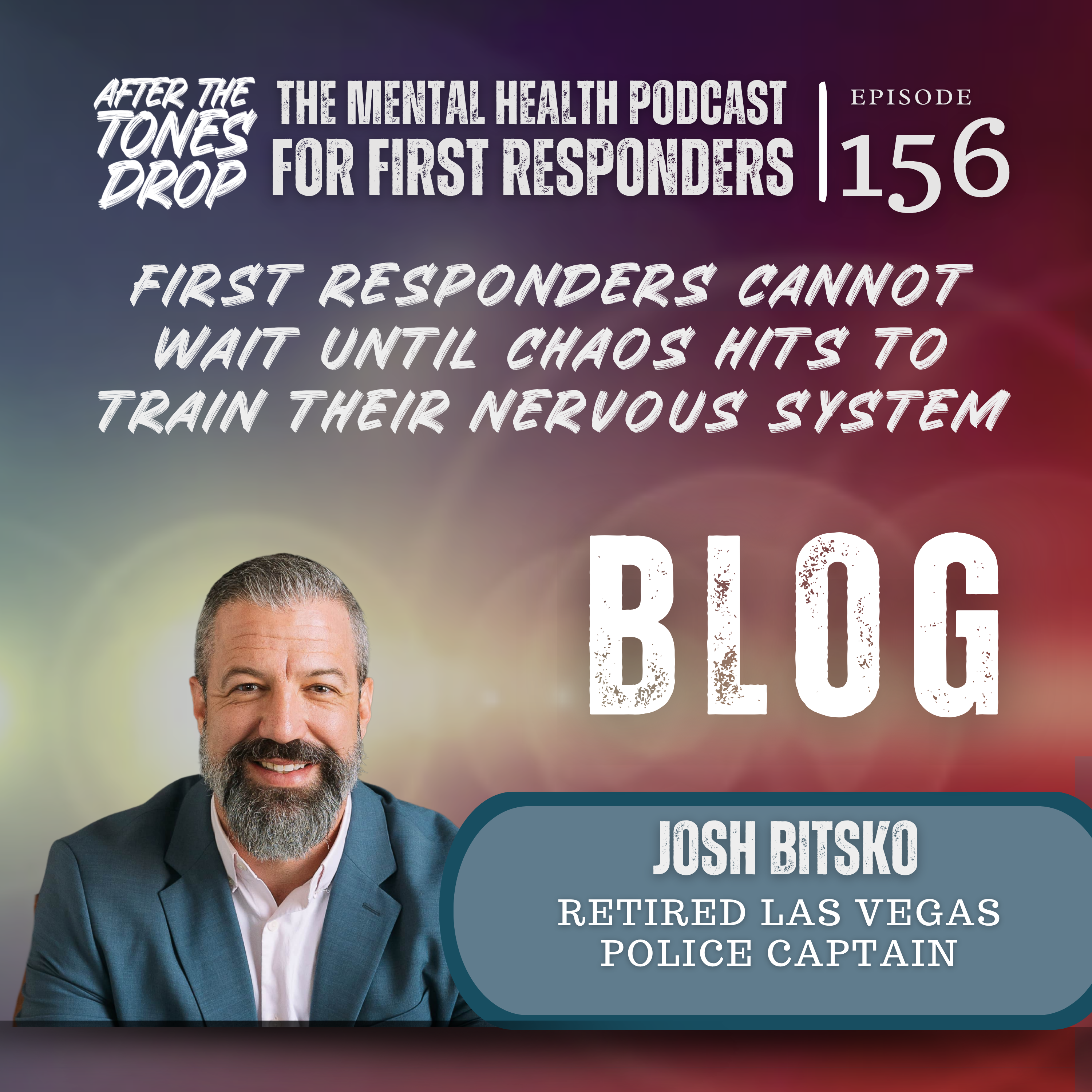
First Responders Cannot Wait Until Chaos Hits to Train Their Nervous System
There is a gap in how we prepare first responders.
We train them to breach doors. We train them to move toward gunfire. We train them to stack up, clear rooms, make entry, neutralize threats, render aid, and keep moving when everyone else is running away.
But too often, we do not train them for what happens inside their own body when chaos hits.
The shaking. The tunnel vision. The dry mouth. The racing heart. The noise. The fear. The pressure to get it right because people are dying, seconds matter, and the whole world might judge what you did from the comfort of a comment section.
That is the part retired Las Vegas Police Captain Josh Bitsko is talking about now.
Josh was one of the responding officers who breached the suspected shooter’s door during the 2017 Mandalay Bay mass shooting. He had been a cop for years. He had experience. He had training. He had been on SWAT missions. He had handled critical incidents before.
And still, he will tell you he made mistakes.
Not because he was weak.
Because he was human.
Chaos Does Not Care How Experienced You Are
One of the most important parts of Josh’s story is that he was not new. He was not some rookie standing there with no clue what to do. He was experienced, trained, and capable.
And that is exactly why his story matters.
Because if someone with that much experience can still look back and say, “I made a mistake because I wasn’t seeing it clearly through the chaos,” then maybe the conversation needs to change.
Maybe the issue is not just whether first responders know what to do.
Maybe the issue is whether their nervous system is regulated enough to access what they know while everything is exploding around them.
Josh talked about responding to the Mandalay Bay shooting and making the decision not to bring his K9 because, based on the active shooter training he had, he thought they were going in to stop a shooter, not use the dog. Later, when they breached the door and had to search for the suspect, he realized the dog would have been a critical tool.
That detail matters.
Not because we need to sit around and beat him up for it. He has already done the work of looking at it honestly.
It matters because this is how first responders learn. Not from sanitized PowerPoints. Not from vague wellness posters. Not from someone pretending everything went perfectly.
They learn when someone who has been there has the guts to say, “Here is what I missed. Here is why I missed it. Here is how you can prepare so you do not make the same mistake.”
That is not shame.
That is leadership.
The Fog of War Is Also a Nervous System Problem
Josh talks about the “fog of war,” and that phrase fits because critical incidents are not clean.
They are loud. Confusing. Fast. Ugly. Human. Nothing looks exactly like the training scenario.
That is the problem with only training for the perfect version of the call. The suspect will not follow your lesson plan. The scene will not unfold like the scenario. Your body will not politely wait until the call is over to have a reaction.
Fear shows up.
Anxiety shows up.
Leadership pressure shows up.
Your body starts trying to survive while your brain is trying to make life-and-death decisions.
That is where nervous system regulation becomes a tactical issue, not just a wellness issue.
This is the part some people still want to roll their eyes at, so let’s say it plainly.
A regulated nervous system does not make you soft. It gives you access to your brain.
If your heart rate is through the roof, your breathing is jacked, your thoughts are narrowing, and your body is flooding with survival chemistry, your ability to think clearly is going to take a hit. That does not mean you are broken. It means you are biological.
First responders are not machines. They are human beings trained to operate in inhuman circumstances.
So the question is not, “How do we make them feel nothing?”
The question is, “How do we train them to notice what is happening inside their body, bring it down enough, and keep moving with better decision-making?”
That is where tools like breathwork, crisis rehearsal, and breaking the incident into smaller steps come in.
Crisis Rehearsal Is Not Overthinking. It Is Preparation.
One of the practical tools Josh talked about is crisis rehearsal.
Not panic rehearsal. Not sitting in the car imagining every possible way things could go sideways until you spiral.
Crisis rehearsal.
What is this going to look like when I get there?
Where am I going to park?
What am I likely to see?
What are people going to be doing?
What is the first decision I need to make?
What is the next step after that?
Josh explained that when he was responding to the Mandalay Bay shooting, he was already thinking through what they might face walking into the casino. People running. Screaming. No clear suspect description. The inability to pat down every single person. The need to keep moving toward the threat.
That matters because the more you can responsibly anticipate before you arrive, the less brain power you have to burn when you get there.
And in chaos, brain power is not unlimited.
Crisis rehearsal helps clear space for the decisions you cannot predict. It gives the nervous system a little less surprise to choke on. It gives the responder a path forward instead of one giant wall of “oh hell.”
You do not rise to the occasion if your body hijacks your brain.
You fall to the level of your preparation.
And preparation has to include the nervous system.
Avoidance Works Until It Starts Eating You Alive
Josh was blunt about what happened after the shooting.
He did not cope. He avoided.
He isolated. He tried not to watch the coverage. He tried not to be bombarded by the story. He went back to work and tried to make life feel normal again.
And here is the brutal part.
Avoidance works.
That is why people keep doing it.
It gives temporary relief. It lets you get through the shift. It lets you function. It lets you put on the face and be “the guy” at work. It lets everybody believe you are fine because you are still showing up and doing the job.
But it does not disappear the trauma.
It stores it.
Josh described slowly detaching. He became more irritable. He blocked the hard emotions, but then he also stopped feeling the good ones. Joy. Happiness. Connection. The stuff that makes a human life feel like a human life.
That is the part first responder culture still does not talk about enough.
You may be able to numb the horror, but you do not get to choose only the emotions you shut off.
Sooner or later, the whole system starts going quiet.
Therapy Should Start Before the Wheels Fall Off
Josh did not start therapy until 2020, three years after the Mandalay Bay shooting. By then, he had also experienced more trauma, more critical incidents, personal losses, and the accumulated weight of a career that kept demanding he keep moving.
His answer to when a cop should start therapy was simple.
The second they graduate the academy.
That may hit some people wrong. Good. Let it.
Because we have treated therapy like something you do once you are already bleeding all over your life. Once your marriage is falling apart. Once your kids do not recognize you. Once you cannot sleep. Once your anger is running the house. Once retirement strips away your identity and you have no idea who you are without the badge, the tones, the rig, the call sign, or the chaos.
That is backwards.
No cop is driving to a fight call, pulling over, and doing push-ups on the side of the road so he can be strong enough when he gets there.
But that is exactly how too many first responders treat mental health.
They wait until the crisis is already here and then try to build the skill.
Therapy is not just where you go because you are “messed up.” Good therapy gives you tools. It helps you understand your own history, your own patterns, your own triggers, and your own nervous system. It gives you a place to say the thing you will not say to your spouse, your boss, your crew, your kids, or yourself.
And no, it is not always fun.
Josh said he still sometimes feels that pit before going. That is honest. Therapy can be hard because talking about hard things is hard. Not because you are weak. Because you are human.
But if the job is going to expose first responders to dead bodies, dead kids, violence, suicide, betrayal, public scrutiny, moral injury, and years of accumulated stress, then therapy cannot be treated like a last resort.
It needs to be part of the maintenance plan.
From day one.
Through promotion.
Through critical incidents.
Through marriage stress.
Through retirement.
And after retirement, when the calls stop but the memories do not.
Retirement Does Not Magically Heal the Job
There is another part of this conversation that matters.
Retirement.
We talk a lot about what first responders need while they are active. We do not talk enough about what happens when they leave.
Because when the job ends, the trauma does not clock out with you.
For many first responders, retirement means losing the structure, the purpose, the social circle, the identity, and the role that held them together for decades. That can be dangerous territory, especially for people who have spent years surviving by staying busy.
Josh talked about purpose being part of what helped him after retirement. Teaching, telling his story, helping other officers, and turning painful experience into something useful gave him a reason to keep moving.
That does not erase what happened.
But it gives it somewhere to go.
And that matters.
First responders do not need to retire into silence. They need connection, care, purpose, and ongoing support. They need people checking in after the badge is turned in, after the bunker gear is hung up, after the radio goes quiet.
The job may end.
The nervous system may still be carrying it.
The Culture Has to Grow Up
The old message was, “If you’re struggling, reach out.”
That is not enough.
Josh said he was never going to reach out. Somebody had to reach in. Somebody had to notice the small changes and refuse to let the easy answer slide.
That is culture.
Not a poster in a break room.
Not a once-a-year training.
Not a checkbox wellness program so leadership can say they offered resources.
Real culture is when someone knows you well enough to say, “You are different. How are you really?”
Real culture is when therapy is normal before crisis.
Real culture is when mistakes are used to teach instead of shame.
Real culture is when first responders are trained not only to survive the call, but to come home with enough of themselves left to keep living.
That is the standard.
And if that feels like too much, ask yourself what the current system is already costing.
The Call Is Not the Only Critical Incident
Josh’s story is not only about Mandalay Bay.
It is about the job after the job. The body after the adrenaline. The marriage after the avoidance. The identity after retirement. The brain after years of pretending it can just keep taking hits without consequence.
It is about the fact that first responders need more than tactical training.
They need nervous system training.
They need crisis rehearsal.
They need therapy before they think they need therapy.
They need people who reach in.
They need leaders who stop confusing functioning with wellness.
Because chaos is coming. That is the job.
The question is whether we are preparing first responders to walk into it with a nervous system that can still think, decide, adapt, and come home human.
Josh Bitsko’s story is not a clean little inspiration package.
It is a warning.
It is a lesson.
And if the industry is smart, it will listen.

Listen to the full conversation with Josh Bitsko on After the Tones Drop to hear more about critical incident mindset, the aftermath of the Mandalay Bay shooting, therapy, crisis rehearsal, and why preparing first responders for chaos has to include the nervous system.
Contact Josh at https://www.joshuabitsko.com

Host
Cinnamon has spent over 25 years in the trenches of trauma work—but for the last eight, she’s been all-in with one mission: making sure the people who run toward chaos have somewhere to land when the dust settles.
She’s a trauma therapist, a trainer, and a national speaker on first responder mental health. From firehouses to squad rooms to conference stages, she shows up with honesty, respect, and the tools to help responders move from surviving to actually living.
And here? She’s your host.
After the Tones Drop is her raw, unfiltered podcast built for the first responder community. Because staying alive isn’t enough. Her work is about reclaiming life—on your terms.

Rest Should Not Have to Be Earned Through Collapse