


 Apple Podcasts
 Spotify
 iHeartRadio
 RSS Feed
 Amazon Music
 "Alive" is Too Low a Bar: Redefining Suicide Prevention
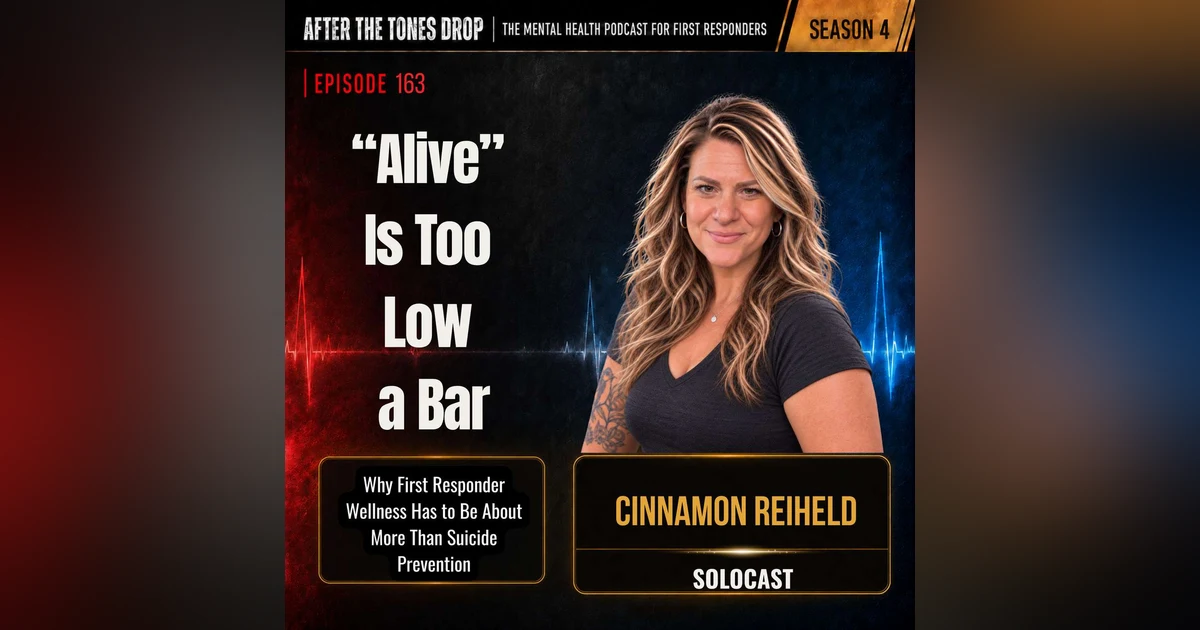
Send us Fan Mail There is an enormous amount of suffering between "I'm doing good" and "I don't want to be here anymore." As Suicide Prevention Month comes to a close, Cinnamon challenges the idea that suicide prevention begins only when someone becomes suicidal. What about the months, or years, before the crisis? What about the first responder who is still showing up, still handling calls, still cracking jokes, but has quietly stopped enjoying their own life? After saying goodbye to Ben, her...
There is an enormous amount of suffering between "I'm doing good" and "I don't want to be here anymore."
As Suicide Prevention Month comes to a close, Cinnamon challenges the idea that suicide prevention begins only when someone becomes suicidal. What about the months, or years, before the crisis? What about the first responder who is still showing up, still handling calls, still cracking jokes, but has quietly stopped enjoying their own life?
After saying goodbye to Ben, her 14-year-old pug, Cinnamon found herself thinking about the way we talk about quality of life when we make end-of-life decisions for our pets, and how rarely quality of life gets the same attention in conversations about human suicide prevention.
She also explains what she means when she says Save a Warrior "saved my life." She is not necessarily saying it stopped her from killing herself. It helped her work through grief, guilt, old trauma, old patterns, and the parts of life that had become increasingly unlivable. Sometimes saving a life means keeping a heart beating. Sometimes it means helping someone get their life back.
Using retired firefighter Jim Burneka's book Overcoming Tuesday as a frame, Cinnamon asks a different set of wellness questions: What does an ordinary Tuesday feel like? Do you sleep? Do you like going home? Do you still laugh? Do you have fun that serves no productive purpose? Does anyone know your truth? Do you know who you are when nobody needs anything from you?
Because most of life is not the five-alarm fire, the officer-involved shooting, the pediatric code, or the line-of-duty death. Most of life is Tuesday.
IN THIS EPISODE:
- Why "alive" is too low a bar for first responder wellness
- Suicide prevention before someone reaches a suicidal crisis
- Grief, Ben, and the question of quality of life
- What Cinnamon means when she says Save a Warrior saved her life
- Jim Burneka's Overcoming Tuesday and the importance of ordinary days
- Sleep, relationships, alcohol, chronic pain, identity, fun, and connection
- Why the uniform cannot be the only thing holding a person's identity together
- Questions that matter before "Are you suicidal?"
- Why "What would make your life 10% better?" can be a powerful place to start
- Peer support and small, practical ways departments can raise the bar
"You don't have to be the sickest person in the room to deserve support. Somebody else having it worse does not magically make you well or make your pain invalid."
"I started this podcast because I wanted to make an impact on suicide rates, but I'm continuing this podcast because I want more of you to actually live."
Resources mentioned in this episode:
- Save a Warrior
- Overcoming Tuesday by Jim Burneka
After the Tones Drop is for educational and entertainment purposes and is not a substitute for professional mental health care, medical care, diagnosis, or treatment. If you are struggling or in crisis, please reach out to a qualified professional or an appropriate crisis resource in your area.
DISCLAIMER:
After the Tones Drop is shared for educational, informational, and entertainment purposes. It does not provide therapy, medical advice, diagnoses, or treatment, and listening does not create a therapist-client relationship. The views expressed are those of the individual speaking. If you need support, please reach out to a qualified professional or emergency services in a crisis. You can also visit our shows resources page for an abundance of helpful information.
ATTD Music Credits (Music from #Uppbeat):
- Our theme music is Intentions by Abby Noise, licensed through Upbeat
- https://uppbeat.io/t/vens-adams/adventure-is-calling License code: ANJCYVHRMULSNKQR
- https://uppbeat.io/t/vens-adams/rise-of-the-hero License code: H4WTAGJZIXZCM8DM
- https://uppbeat.io/t/yeti-music/homewardLicense code: KO7FZAIJBAEAJLKE
- https://uppbeat.io/t/sonda/the-heart-grows License code: KAID0ITO96GJZAPS
- https://uppbeat.io/t/philip-anderson/achievement License code: XZ4PMCKHW94GUR74
- https://uppbeat.io/t/tobias-voigt/nexus
License code: MVMDRGHKHTJRABVR - https://uppbeat.io/t/paul-yudin/breakthrough
License code: FYPM3OJF0NQ4OGTE
There's an enormous amount of suffering between I'm doing good and I don't want to be here anymore.
SPEAKER_00I'm Cinnamon, and this is After the Tones Drop.
SPEAKER_01Welcome back to After the Tones Drop. This is Cinnamon, your host, and we are getting to the end of Suicide Prevention Month. And I haven't talked about it yet. I have a lot of feelings about this particular topic. And my whole schedule for this month got thrown off when expectedly but unexpectedly, we had to put our dog down. And if you're a dog owner and have ever done this, or a cat owner, I don't know. I tend to talk about it with dog owners a lot more. But it is a really hard decision because you're balancing your desire to not be the one that causes your dog's death. I'm sure there are a lot of people who have prayed that their dog was just taken gently in his sleep so they didn't have to make that decision. But balancing their quality of life with the sacrifice that even we make, ending our time with them. And, you know, one of the things that people love to say that I have said um about Ben's time on earth and his his passing away is that dog had a beautiful life. He was brought home at six weeks by my husband, and he fit in his hand at the time, and he has not been far from either one of us for too long. I came into his life when he was about four. He died at 14, and that decade was a very glorious decade for that pug's life. And, you know, I'm sure that we know people try to make the grief a little lighter if you gave your dog a good life. And, you know, I joke and say when my clients would come, Ben would always greet them at the door. And when his mobility began to decline, and he would sit on the love seat with me and would wait for the clients to come in. Uh, they would approach him, kiss his little head or paw, kiss his ring, and then proceed to go sit in the blue chair, which is we refer to the therapy seat where my clients tend to sit in as the blue chair. And my dog did have a really good life. And it happened to be in the midst of Suicide Prevention Month. And it's amazing to me how that's how we talk about supporting someone grieving in that way, but we tend to forget about the quality of life that humans have when we hear that they have taken their own life. And I've been on this mission in the last year or two to start rethinking what suicide prevention means. I work with Save a Warrior very closely. And when I describe it as a suicide prevention program, a lot of people might say, well, it's not like I actively, you know, want to kill myself right this minute. Or what if I've never thought about suicide? And as somebody who has attended Save a Warrior, who freely and frequently says that the program saved my life, I don't necessarily mean that the program kept me from killing myself. What I mean is it saved the life, the quality of the life I was living. Because I was struggling when I went to save a warrior. And it was shortly after my client's own suicide where I felt that I had failed. And so my big, beautiful life had shrunk immensely and was full of hesitation and fear and grief and guilt. And that wasn't the kind of life that I wanted to live. And so it did, it saved my life, just not in the way that we think about it. And the whole quality of life discussion seems like it's been left out of suicide prevention conversations. You know, there are a whole lot of ways to lose your life without actually dying. You can lose your marriage, you can lose your friends, your sleep, your sense of humor, relationships with your kids, your ability to sit still, to enjoy retirement that you looked forward to and counted down to, the interests that you have and things that you used to enjoy, your identity outside the job. You can gradually lose almost everything that once made your life feel like yours, and still wake up every morning, put on the uniform, whatever uniform that is, and go to work. And nobody calls it a crisis because you're still alive. But I've said this a million times: alive is too low a bar. And because September is suicide prevention month, it feels like an especially important conversation to have right now. Because every September we talk about suicide, we talk about warning signs, we talk about crisis lines, we talk about knowing what to do when someone says they don't want to be here anymore. We talk about how to ask the direct question. And all of that absolutely matters. Absolutely. But if we're serious about preventing suicide, then I think we need to spend a hell of a lot more time talking about what happens before someone becomes suicidal, sometimes years before, because there's an enormous amount of suffering between I'm doing good and I don't want to be here anymore. There is a whole lot of life in there. So what if they're not suicidal? What if they just don't particularly like their life anymore? They're still showing up, they're still handling calls, they're still paying the mortgage, they're still cracking jokes with their crews, they're still answering the radio, they're still functioning well enough that nobody is especially worried. Nothing has happened dramatic enough for anybody to say, holy shit, we have a crisis. Even a buddy of mine who's been struggling recently. I was talking to somebody else, and they're like, Oh yeah, he's struggling. And I'm like, and what are we doing? Like, what are we doing about the fact that he's struggling? And I talked to him and he's like, I'm struggling. And I'm like, what are you doing? And he's like drinking and hoping that it passes. And, you know, for that, it's like we don't really know what to do except say, I'm here for you. Here's a phone number. Do you want to hurt yourself? And then if they say no, it's like, oh, okay, well, then you're just struggling. But I don't want to wait till somebody says, holy shit, we have a crisis. You know, they haven't slept well in years. Like they couldn't tell you the last time they slept well, or their marriage is barely hanging on. They're drinking more than they want to admit, or more than they normally do. Nothing is especially fun anymore. They're irritated or irritable most of the time. They haven't talked to one of their good friends outside of the job in months. Their kids know when their parent gets home, it's probably better to give them a little space. They sit in a driveway before going inside because neither work nor home feels particularly comfortable anymore. And somewhere along the way, the person underneath the uniform got really fucking hard to find. And they're alive. But is that really the standard? Because I want fewer first responders to die. Of course I do. But I want a hell of a lot more for them than simply remaining biologically alive. So Save a Warrior helped me work through things that were quietly killing my quality of life. It saved my life from continuing to go down the shitter one time to make the donuts kind of day at a time. Wake up, do the things, go to work, handle whatever needs handled, be productive, be useful, solve problems, go home, repeat, wake up, do the things, be useful, repeat. Nothing dramatic enough to qualify as an emergency. But taken together, some parts of my life were becoming increasingly unlivable. Old trauma, old patterns, old relationships, old ways of thinking, ways of coping, ways of feeling, ways that I had learned to survive that had been incredibly useful at one point and were not necessarily very good ways to live anymore. And there's a difference between surviving and living. And I think sometimes we use the phrase saved my life too narrowly. Sometimes saving somebody's life does mean keeping them from dying. And sometimes it means helping them get their life back before they completely lose it, before their marriage implodes, before the drinking takes over, before the relationships disappear, before they burn every bridge, before they retire and realize they have no idea who they are, before they wake up one morning and discover they have successfully survived 25 years that they barely remember enjoying. That counts too. And I want more of that. A retired firefighter friend of mine, Jim Barnica, wrote a book called Overcoming Tuesday. And I love that title because Tuesday is exactly what I'm talking about. Not September 11th, not the five alarm fire, not the officer-involved shooting, and not the pediatric code, not the line of duty death, but just Tuesday, the completely ordinary day where the alarm goes off, you get up, you go to work, you come home, you scroll through your phone, maybe you watch some TV, you go to bed, and then you do it again. Those are the days where most of a life is actually built. And those are also the days where a life can quietly disappear one Tuesday at a time. So I've become increasingly interested in a very simple question. What does the day-to-day feel like? Do you sleep? Did you sleep? When you wake up, are you already irritated? Do you like going home? When you get there, are you actually mentally there as well as physically? Do you like your spouse? Does your spouse still like you? Do you love your spouse, but maybe are not in love with your spouse? Do your kids experience you as part of their lives or mostly as somebody who happens to live in their house? Do you have friends that you actually enjoy? Do you have anything in your life that is fun? And I mean fun without an outcome, not training for something, not fixing something, not accomplishing something, not getting certified, not turning a hobby into another side hustle, but just fun. If you need to hear more about why I am so passionate about fun, go back and listen to the first episode of season four, or go back to my episode with Dina Ali and hear those discussions around fun. Can you sit still without feeling guilty, without doing? Can you take a vacation without checking on the group chat before breakfast? Can your kids tell you some 20-minute story that has absolutely no point whatsoever? And you stay mentally in the room long enough to hear it without rolling your eyes, sighing, or white-knuckling it? Do you still flirt with your spouse? You still having sex? Do you laugh? Like that real laugh, not like the chuckle. I thought that was funny, but when it surprises you so much that a noise comes out of you. I remember driving the 395 in California and I popped up over the hill and unexpectedly there was this big lake. I found out later it was mono lake. And I had definitely started getting used to being in the car alone after I dropped my fan off at the airport in Palm Springs. But I remember coming up over that hill and just bursting out laughing. And I'm like, of course there is a lake. Because if you drive from Southern California to Northern California, the landscape is so different. So boop, there was a lake. That's a Tuesday. Do you have something coming up that you're genuinely excited about? Do you know who you are when nobody needs anything from you? That's Tuesday. And Tuesday is most of your life. Public safety is incredibly good at responding when Tuesday catches on fire. Something explodes, everybody moves. Someone stops breathing, there's a protocol. A Mayday goes out, the system activates. Someone says, I'm thinking about killing myself. Now everybody understands that something serious is happening. But what about the 12 months before that? About when they stopped sleeping, or when they stopped complaining about being tired because they were just always tired. When they stopped laughing, when they stopped calling their friends, when three drinks quietly turned into six, when they stopped going to the gym, they stopped enjoying days off or picked up more shifts because it was easier to be at work where you knew exactly what was expected of you, rather than feeling like a failure at home. When their spouse started saying, you're here, but you're not really here. When the job became the only place, they still felt competent. When every day started feeling like time to make the donuts, nothing is technically on fire, nothing dramatic enough to trigger an intervention, just less life, a little less connection, a little less joy, a little less hope, a little less patience, a little less curiosity about what comes next. That person may never say, I want to die, because I have found that most people who die by suicide, it's not that they want to be dead. They may simply stop wanting very much at all. And I think we need to care about that person long before we're asking whether or not they have a plan or intent. Because if our entire wellness strategy is designed around keeping somebody from killing themselves, we have waited far too long to start caring about how they're doing. This is where my own understanding of first responder wellness has changed over the years. When I first entered this work, it was because of a critical incident. It was because of a line of duty death. And so, of course, I thought mostly about the big things, the trauma, the PTS, the addiction, the critical incidents, the suicide. And obviously, I still deeply care about every one of those things. The reason that I kept going after that, and I jokingly say because I discovered that first responders were fucked up far beyond this one critical incident. But the longer I do this, the more interested I become in something that sounds considerably less dramatic. And that's quality of life. Like, do you actually like your life? Not, are you grateful? Do you know intellectually that you have things that other people would love to have? Not should you be happy? Do you enjoy participating in your own life? Because I don't want someone to merely survive 25 years in the fire service. I want them to still have a marriage when they retire, assuming it's a marriage worth keeping. I want cops who can walk through the front door after a shift and actually arrive home and not just worry about getting that belt off to relieve the pain from their hips. I want dispatchers who can leave some of those voices at the console. I want medics who can feel something besides exhausted. I would love to see COs who can remember what safety feels like when they leave the institution. I want people who can sit still without needing the tones or a call to come out before they finally feel alive. I want people to know their kids and I want their kids to know them. I want vacations and hobbies and stupid inside jokes and bad golf trips and fishing and gardens and motorcycles that they absolutely do not need. Some ridiculous old truck that will cost three times more to restore than it will ever be worth. I want people learning guitar badly, taking road trips, sitting on beaches, having good sex, having dinner with people who make them laugh, falling in love over and over again, getting divorced when divorce is healthier, getting remarried if they want to, going to therapy before everything is falling apart, going to therapy even when nothing is falling apart. I want first responders to have lives big enough that the job can be incredibly important without becoming the only thing holding their identity together. Because when the uniform becomes the whole person, anything that threatens that uniform starts to threaten the self. An injury, an investigation, a transfer, a failed promotion, retirement, organizational betrayal. Suddenly the question stops being, what happens to my career? And it becomes, who the hell am I now? I'd really like us to start answering that before someone loses the career. And this is why I think we need to broaden what we call suicide prevention. Protecting relationships is suicide prevention. Treating addiction early is suicide prevention. Sleep, getting it in quality doses, is suicide prevention. Addressing chronic pain is suicide prevention. Building identity outside of the job is suicide prevention. Helping somebody talk about shame is suicide prevention. Creating spaces where somebody can say, this thing happened and I'm not okay without immediately worrying that they've just jeopardized their career is suicide prevention. Teaching leaders how not to unnecessarily injure their own people is suicide prevention. Making mental health treatment genuinely confidential. And culturally competent is suicide prevention. Helping somebody reconnect with their spouse, suicide prevention. Helping somebody recognize that their anger is covering fear or sadness or grief. That's suicide prevention too. Helping somebody remember how to enjoy a Tuesday. I think that's suicide prevention too. Because I don't want the finish line to be, congratulations, you didn't die. That's a pretty shitty definition of wellness. The question that I'm much more interested in is how do we help people build lives they actually want to stick around for? That changes the conversation. Instead of only asking, are you suicidal? Maybe we also ask, what still feels good? What have you stopped doing? Who knows how you're actually doing? Does anyone know your truth? What does home feel like? What are you excited about? When was the last time you rested without feeling guilty about it? Like sat on the sofa and didn't go to the to-do list? When did you last do something that served absolutely no productive purpose? What's getting harder? What are you tolerating right now that you probably shouldn't be? When do you feel most like yourself? And one of my favorites from the therapist playbook is what would make your life 10% better? Those aren't emergency questions. That's the entire point. We need more conversations before emergency becomes the only language available. You don't have to be the sickest person in the room to deserve support. You don't have to earn care by hurting badly enough. Somebody else having it worse does not magically make you well. Oh, I'm going to say this again. Somebody else having it worse or being worse off than you does not magically make you well or your pain invalid. And you absolutely do not have to wait until rock bottom to decide that you'd like your life to feel better. Rock bottom is a terrible intervention strategy. Give me a Tuesday. Give me, I don't really know what's wrong. I just know I don't feel like myself. Give me the moment you notice you're drinking more. When your spouse says you're not really here these days, when sleep gets weird, when you're snapping at the kids, when the nightmares start, when you stop answering invitations, or your answer to the invitation is just no, I'm busy that night. When you notice you're becoming someone that you don't particularly like, that is the moment because you're not broken, because something is changing. And things are usually a hell of a lot easier to change before the entire house burns down. So during suicide prevention month, yes, let's talk about suicide. Let's talk about the warning signs. Let's make sure that people know crisis resources exist. Let's check in on each other. Let's intervene when someone is in immediate danger. But if we really mean prevention, then let's also have the conversations happen much earlier, months earlier, years earlier, before the person ever thinks about dying. Prevention happens when pain and suffering have a language, when shame loses some of that oxygen, when somebody says me too, when a chief checks on somebody because they actually care, not simply because policy says they should, when a spouse understands that the anger actually might be fear and it's really not directed at them, despite how much it feels like it is. When somebody learns that hypervigilance may have kept them safe at work and is simultaneously destroying their sleep at home. When somebody discovers that asking for help doesn't erase their strength. And in fact, it can prove it. That is saving a life too. Not only keeping the heart beating, but helping somebody get their life back. And that's what I want after the tones drop to be about. Yes, I want fewer first responders to die, but I also want better Tuesdays, more responders who understand that underneath everything they do for everybody else, there is still a human being who deserves a life of their own. I want people who are not merely alive. I want them present, connected, curious, hopeful, loved, loved well, able to be useful when they want to be useful, and completely useless on a Sunday afternoon if that's what they need. Because alive matters, of course it does. But alive is just too low of a bar. I started this podcast because I wanted to make an impact in the suicide rates. But I'm continuing this podcast because I want more of you to actually live. That's all I have this week for Suicide Prevention Month. I hope some of this resonated with you. If it made you think of yourself, check in with somebody. If it made you think that maybe you aren't checking on somebody enough, go do it. If it means that you need a refresher on what those resources are in your area, go find them. But there are ways of raising that bar that don't require a ton of work. It's just making sure you're paying attention and you're connected and you're brave enough to say when something isn't working. Thanks for listening, and I'll see you next week. After the tones drop is shared for educational, informational, and entertainment purposes. It does not provide therapy, medical advice, diagnoses, or treatment, and listening does not create a therapist-client relationship. The views expressed are those of the individual speaking. If you need support, please reach out to a qualified professional or emergency services in a crisis. Our theme music is intentioned by Abby Noise, licensed through update.