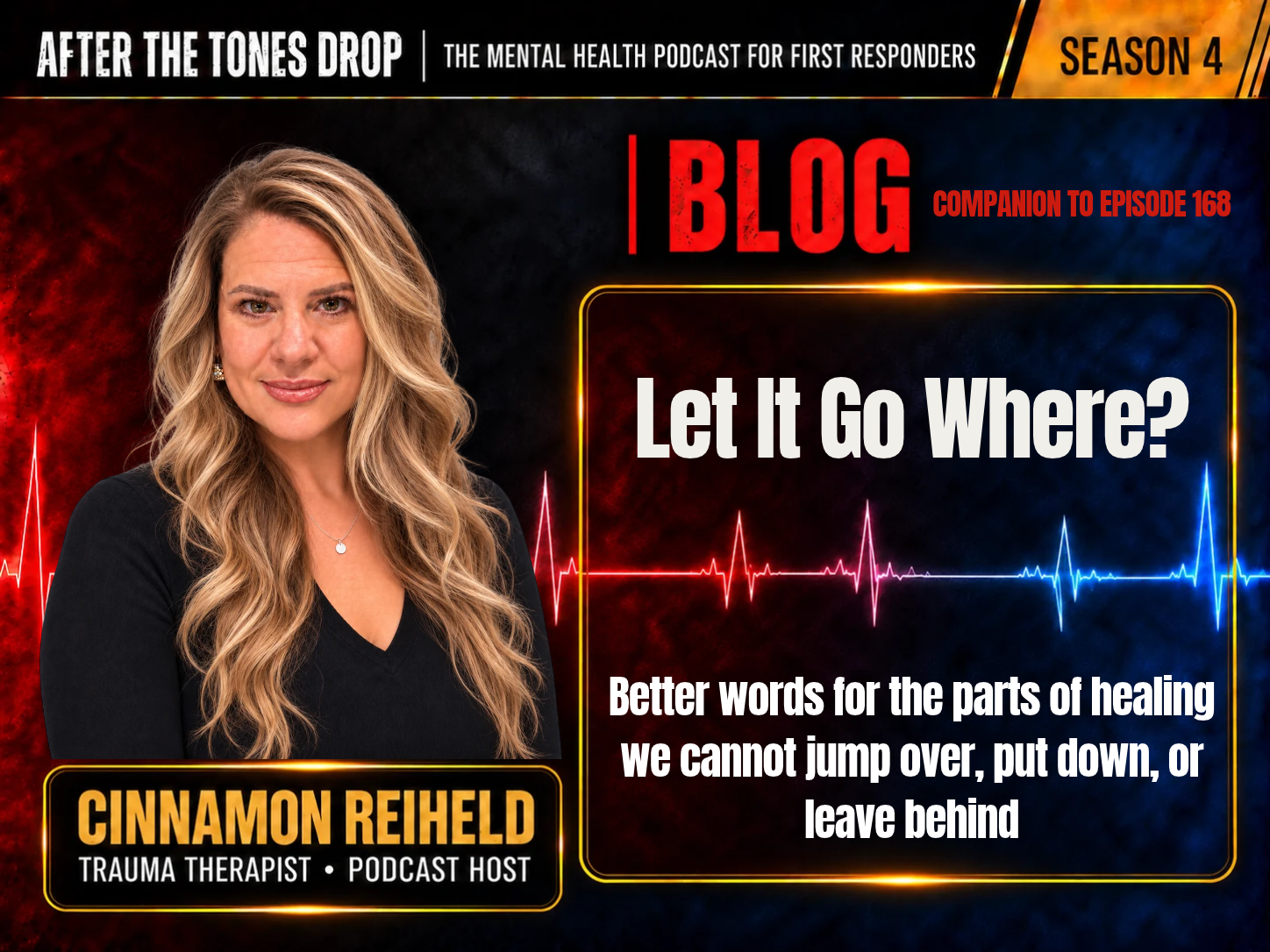
Let It Go Where?: Better words for the parts of healing we cannot jump over, put down, or leave behind
“Let it go.”
Okay. Where?
Is there a designated drop-off? A bin behind the station? Do I need an appointment, or can I just show up with twenty years of things I was supposed to stop carrying?
I understand what people usually mean. They want relief for us. They want the painful thing to loosen its grip. Sometimes we want that so badly ourselves that we repeat the instruction without questioning it.
I need to let this go.
I should be past this.
Why can’t I get over it?
But listen to the picture those words create.
There is an obstacle. You get over it. There is a place you leave. You move past an object of pain. There is an artifact of your past in your hands. You put it down.
And if you are still hurting, the picture suggests you have failed to complete a fairly straightforward task.
That is a hell of a thing to imply about someone who is already trying.
The episode “Healing Language That Hurts” examines those pictures. Here, I want to give us some language we can actually use when the old phrases do not fit.
“Get Over It” becomes “Find Your Footing”
Getting over something suggests there is a far side where the experience no longer reaches you. Or it's a hurdle you still have to get "past."
Finding your footing allows for the fact that you are standing somewhere that has changed.
Maybe a loss changed your family. Maybe a call changed what feels safe. Maybe a betrayal changed what you are willing to accept from people.
You are trying to figure out how to live here.
Instead of “You need to get over this,” try:
“What would help you feel steadier right now?”
For yourself:
“I’m learning how to find my footing again after what happened.”
That gives you something to investigate. You can need steadier footing today without declaring that every step you have taken so far was wasted.
“Let It Go” → “Change How You Carry It”
“Let it go” can sound as though you are gripping the painful thing on purpose. And the implication is you're basically an idiot for keeping your hand on the hot stove that is hurting you.
Sometimes people do hold tightly to an argument or a story. Sometimes there are choices to examine. But an unwanted memory or a wave of grief is not automatically evidence that you refuse to open your hands.
“Change how you carry it” makes room for a different goal. The experience may become less consuming. You may find support, understand it differently, or have more choices about how you respond when it comes up.
Instead of saying to someone “Just let it go,” try: “How could we make this less heavy for you?”
For yourself:
“I want this to take less out of me. I may need help figuring out how.”
That does not require you to promise to carry the same pain forever. Relief is allowed. So is needing more than an instruction to get there.
“Move On” → “Make Room for What Comes Next”
“Move on” can sound like an eviction notice. And it can be hard when what you're moving on from is something you treasured that tragedy took and grief becomes the placeholder.
Your grief has occupied this space long enough. Please vacate so normal life can resume. Please be ok so I don't have to deal with my discomfort with your lack of "ok-ness."
But people can want a future and still have feelings about the past. A widow may want companionship and still love the person who died. A retired responder may want a new purpose and still miss the crew. Healing does not result in amnesia.
Making room gives the future somewhere to enter without demanding that everything else disappear first.
Instead of “It’s time to move on,” try: “What would you like to have more room for in your life?”
For yourself: “I can make room for something new while this still matters to me.”
The answer might be small. An afternoon with a friend. A hobby you abandoned. A conversation that has nothing to do with the loss.
You do not have to solve the whole future before participating in a piece of it.
“Put It Behind You” → “Let It Become Part of Your History”
“Behind you” sounds reassuring until something brings the experience right back into view. And a reminder can quickly turn into a failure.
A smell. An anniversary. A familiar street. Then you may wonder why you are facing something you supposedly left behind.
There are certain life experiences that can still make me emotional, can still bring tears to my eyes. I'm not emoting because I've failed to heal, I'm emoting because it's a loss and it will never not be a loss. That doesn't mean I need comforted or even that I'm not at peace with what happened. It just means it was, and likely may always be, a sad event.
Being part of your history allows the experience to have happened and to have mattered. It also leaves room for your life to become larger than that one part.
Instead of “Put it behind you,” try: “What would help this feel less like it is running your life now?”
For yourself: “This happened to me. I’m working on having more choice about how it affects me today.”
That is an aspiration. You do not have to pretend you have arrived there.
“Don’t Let It Define You” → “There Is More to You Than This”
People often mean well when they say, “Don’t let it define you.”
But what if the experience changed something fundamental? What if it changed your priorities, your relationships, your work, or what you believe? There was a you before, and now there is the you after. You should not have to deny that change to preserve your identity.
“There is more to you than this” allows the experience to matter while keeping the rest of the person in view.
Instead of “Don’t let it define you,” try: “This is part of your story. What other parts of you need some attention?”
For yourself: “What happened changed me. I’m still discovering who I am alongside it.”
Maybe you are still funny. Still curious. Still someone who loves terrible movies and makes excellent pancakes.
Those parts of you get to have room, too.
“I Should Be Over This by Now” → “This Still Needs My Attention”
The words “by now” smuggle a deadline into the conversation. Says who? Whose timeline? Since when are "they" the boss of you? You can notice that you are struggling without making the elapsed time evidence against you.
Instead of “I should be over this by now,” try: “This is still affecting me. What kind of support would help?”
That question can lead somewhere. You might need a different approach, a conversation you have avoided, help with something happening now, or professional support. You can take persistent pain seriously without treating it as a character flaw.
Better Language Has to Leave Room for the Person
None of these replacements is a password that makes pain disappear. And a metaphor that helps one person may irritate the hell out of another. Someone may love the idea of carrying an experience differently. Someone else may say, “I am tired of carrying anything.”
Listen to that answer.
You can ask, “What words fit better for you?” Or drop the imagery entirely: “What is hardest today?” “What would help?” “Do you want company?” Or even a more direct and possibly supportive statement in lieu of the classic, "Let me know if you need anything" to "I'm coming over and bringing Chipotle and we can watch a movie and I can help with the laundry."
Sometimes the most useful thing we can say is plain enough that nobody has to translate it. And sometimes we need to change how we talk to ourselves before we can imagine a different way forward.
Try finishing this sentence: “I don’t need to get over ________. Right now, I need help with ________.”
Name the actual difficulty. Sleeping. Going back to that place. Talking about what happened. Having a quiet evening without feeling alone. No one has effectively shamed themselves or been shamed into a healthy place. Not really.
Give yourself a task that belongs to your life while giving yourself grace for where you are in the process. You have spent enough time trying to jump over something nobody could tell you how to clear.

Host
Cinnamon has spent over 25 years in the trenches of trauma work—but for the last eight, she’s been all-in with one mission: making sure the people who run toward chaos have somewhere to land when the dust settles.
She’s a trauma therapist, a trainer, and a national speaker on first responder mental health. From firehouses to squad rooms to conference stages, she shows up with honesty, respect, and the tools to help responders move from surviving to actually living.
And here? She’s your host.
After the Tones Drop is her raw, unfiltered podcast built for the first responder community. Because staying alive isn’t enough. Her work is about reclaiming life—on your terms.

Loving Someone Whose Apology Is Real and Still Not Enough: When ADHD Explains the Pattern but the Relationship Still Has to Live With It