


 Apple Podcasts

 Spotify

 iHeartRadio

 RSS Feed

 Amazon Music
Healing Language That Hurts: How Good Intentions and Bad Metaphors Undermine Recovery
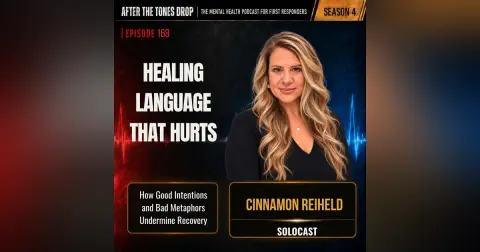
Send us Fan Mail “Let it go.” “Move on.” “Put it behind you.” These phrases usually come with good intentions. But when you’re living with trauma or grief, they can leave you wondering why you’re still hurting and whether you’re doing healing wrong. In this episode of After the Tones Drop, Cinnamon examines the everyday language that turns recovery into an expectation to forget. Drawing from her work as a therapist and her own experiences with loss, she offers another way to picture healing: ...
“Let it go.” “Move on.” “Put it behind you.”
These phrases usually come with good intentions. But when you’re living with trauma or grief, they can leave you wondering why you’re still hurting and whether you’re doing healing wrong.
In this episode of After the Tones Drop, Cinnamon examines the everyday language that turns recovery into an expectation to forget. Drawing from her work as a therapist and her own experiences with loss, she offers another way to picture healing: a cloud that once crowded your face gradually settling around your ankles. It doesn't leave you, you just learn to walk with the experience differently.
The memory may still be there. It may stir when the wind picks up. But it doesn’t have to obscure everything in front of you.
For first responders, their families, and anyone who has been told they should be “over it,” this conversation makes room for remembering, recurring grief, and progress that doesn’t follow a straight line.
In this episode:
• Why familiar healing phrases can create shame and self-blame.
• How “moving on” becomes confused with forgetting.
• Why peace and emotion can exist alongside each other.
• The cloud-at-your-feet metaphor for carrying painful experiences differently.
• Everyday signs of healing, including responding differently to triggers and making room for sadness.
• Why a difficult day doesn’t erase the work you’ve already done.
Episode chapters:
00:00 — Show intro
00:19 — “Let it go”: when helpful words land like bricks
00:58 — The hidden message in our healing language
02:23 — Unpacking the metaphors: whose timeline are we following?
03:30 — Personal loss and the pressure to grieve correctly
04:00 — When remembering turns into self-blame
05:53 — A different metaphor: the memory at ankle level
07:57 — What healing can look like in everyday life
08:58 — Rewriting the story with compassion
10:10 — Closing disclaimer and credits
A thought to carry with you:
“You don’t need amnesia to prove that you’re healing.”
Content note: Discussion of trauma, childhood adversity, miscarriage, and the death of a loved one.
DISCLAIMER:
After the Tones Drop is shared for educational, informational, and entertainment purposes. It does not provide therapy, medical advice, diagnoses, or treatment, and listening does not create a therapist-client relationship. The views expressed are those of the individual speaking. If you need support, please reach out to a qualified professional or emergency services in a crisis. You can also visit our shows resources page for an abundance of helpful information.
ATTD Music Credits (Music from #Uppbeat):
- Our theme music is Intentions by Abby Noise, licensed through Upbeat
- https://uppbeat.io/t/vens-adams/adventure-is-calling License code: ANJCYVHRMULSNKQR
- https://uppbeat.io/t/vens-adams/rise-of-the-hero License code: H4WTAGJZIXZCM8DM
- https://uppbeat.io/t/yeti-music/homewardLicense code: KO7FZAIJBAEAJLKE
- https://uppbeat.io/t/sonda/the-heart-grows License code: KAID0ITO96GJZAPS
- https://uppbeat.io/t/philip-anderson/achievement License code: XZ4PMCKHW94GUR74
- https://uppbeat.io/t/tobias-voigt/nexus
License code: MVMDRGHKHTJRABVR - https://uppbeat.io/t/paul-yudin/breakthrough
License code: FYPM3OJF0NQ4OGTE
I'm Cinnamon, and this is After the Tones Drop. Let it go. Move on. Put it behind you. These phrases are tossed around like inspirational confetti. But for people healing from trauma, ugh, they can land like bricks. In this episode, we're unpacking the metaphors we use when we're talking about healing and how some of them shame us into silence. We'll rewrite them and replace them with something more honest, more accurate, and more compassionate. Because healing doesn't always look like release. Sometimes it looks like walking beside the memory instead of living inside of it. Let's talk about something I see all the time in therapy, in conversations, and in the TJ Max aisle, truth be told. It's really about the language that we choose around healing and how it actually is counterproductive. It hurts instead of adds to the process. You know, the ones let it go, turn the page, move past it, put it behind you. You should be over that by now. Or you have to move on. Even the self-talk, like I can't get over it, so I must be broken. I think they're said with love most of the time, with frustration other times, but they almost always carry the same underlying message. If you're still dealing with it in some way, shape, or form, there must be something wrong with you. And here's the truth: most of these metaphors imply erasure, right? Like the goal of healing is to scrub the slate clean and pretend that event never happened. So if you're someone who still feels it, if you still have waves of emotion, if the past still follows you into the present, you start to think that you're doing healing wrong. But you're not failing. You're just using someone else's map. So we're gonna burn the map. There are these metaphors and phrases that sound empowering until you actually live with trauma. So turn the page. Okay, well, what if the story bleeds into the next chapter? What if it shows up in the margins? Cut the cord. Trauma doesn't come with scissors. Some things are entangled, not just connected. Let it go. Let it go where? What if it clings because it hasn't been witnessed? And trauma and grief need to have a witness. Put it behind you. I can tell you I have a wrestling belt and a bowling pin and a signed autograph photo of Jimmy Mouth of the South Heart behind me. What I do not have behind me is my childhood. It doesn't work that way. I should be over it by now, as if some tragedy that I've endured is a hurdle on a track at a high school meet. And even if we did say, I should be over it by now, says who, according to whose timeline. One of the things that I talk about when I talk about grief is what my friend Sarah told me when called her up after I'd had a miscarriage. And I was like, is this normal? Is this normal? Is this normal? And she's like, the answer to all of that is yes. And any other questions that you have for me, the answer is yes. Everything is normal because this is a normal response to an abnormal situation. We've heard that, right? What all these things have in common is this. They assume that healing is about forgetting and about never getting emotional when it comes up. And when you can't forget, or it still elicits emotions because your body remembers, your nervous system remembers, your relationships carry the echoes of it, you start to blame yourself like you're failing, like you're not grieving and moving on appropriately. So you start asking questions like, why am I still like this? Why can't I just let this go? Why do I still think about it? But what if the issue isn't that you're stuck? What if the issue is that no one gave you a way to carry it differently? And because we've packaged healing up in these ridiculous metaphors, we don't even know what differently could look like. And what if the fact that you still feel doesn't actually mean that you're broken? Because we know you're not broken. It just means that you're still in relationship with a wound that shaped you. I can still get emotional about the loss of my pregnancy because I'm in relationship with that event. And I can also be at peace with that event and still get emotional. So here's a different metaphor that I have worked out for myself and that I share with clients. And I feel like it's more helpful and it actually is more accurate as a metaphor. Because, like I said, Jimmy Mouth of the South Heart is not my childhood. But if you were in the room with me and you looked behind me, that is what you would see. Although Jimmy Mouth of the South Heart was actually a very significant part of my childhood, uh, but not the bad part. Now, Bobby the Brain Heenan, maybe that I digress. All right. So here is my metaphor. And it starts out with healing is when a memory drops to ankle level. Bear with me. It's not gone, it's not buried, it's just no longer like choking you, and it's not right up here all the time. The metaphor is this trauma used to be at face level, right? Right up here, constant, clouding my vision, making it hard to breathe through. But over time, with work, with support, with your nervous system slowly shifting, that cloud descends. It's still with you, but now it brushes up against your ankles instead of smothering your lungs. And it makes space for recurring grief without self-judgment. So it can float up and be acknowledged and then go back down. It's still with me, right? So it makes space for complex trauma without collapse and it triggers without complete and total disorientation. It gives you permission to still remember, to still have waves, to still have bad days. You're not broken, you're accompanied. This is an experience that you've had, and it is going to be with you the remainder of your journey. It doesn't mean that it has to be right in your face, but it's not going to be left behind. And when the wind kicks up, yeah, the cloud might swirl again and you might feel it more. But you're not back at square one. You're just human in weather. And I am certainly not in the same place that I was a couple years ago with the death of a person that I cared about. But that doesn't mean that I can't talk about him and still get emotional. It doesn't mean that I can't have moments where the grief is back, but it doesn't get me like it did in the beginning. So here is what real healing looks like. Real healing isn't perfect boundaries every time, never getting triggered, forgetting it ever happened. Real healing looks like feeling the trigger and still choosing to not explode. Or noticing the sadness and giving it space without shame or judgment. Being able to say, Yeah, that still lives with me, but it doesn't own me. It looks like remembering an anniversary and not being destroyed by it. Being able to tell the story out loud for the first time. It looks like having the same damn nightmare and not hating yourself for it. Real healing is the cloud at your feet. It's in your awareness, but it's no longer in control. You don't need amnesia to prove that you're healing. You don't have to fake a blank slate. So we're gonna rewrite this story. You're not supposed to forget. You're supposed to live alongside what shaped you. You're not carrying it wrong. You just haven't you haven't had help redistributing the weight. You're not stuck, you're still healing. And healing, oh my goodness, do we not know yet that healing is not linear? It spirals, it loops, it gets close up, it dances far away, but it lingers. So that cloud at your feet, it's not failure. It's proof that your story still matters and that you're learning to carry it differently. So please, can we agree to ditch the shame-based metaphors? Let's stop expecting ourselves to disappear the past. You're not failing at healing, you're doing it exactly the way your nervous system knows how. So let's meet that with compassion and better metaphors. Thanks for hanging out with me, and thanks for listening. Have a great week. After the tones drop is shared for educational, informational, and entertainment purposes. It does not provide therapy, medical advice, diagnoses, or treatment, and listening does not create a therapist-client relationship. The views expressed are those of the individual speaking. If you need support, please reach out to a qualified professional or emergency services in a crisis. Our theme music is intentions by Abby Noise, licensed through upbeat.