


 Apple Podcasts

 Spotify

 iHeartRadio

 RSS Feed

 Amazon Music
"I'm Sorry....and it Might Happen Again": ADHD, Accountability and Repair
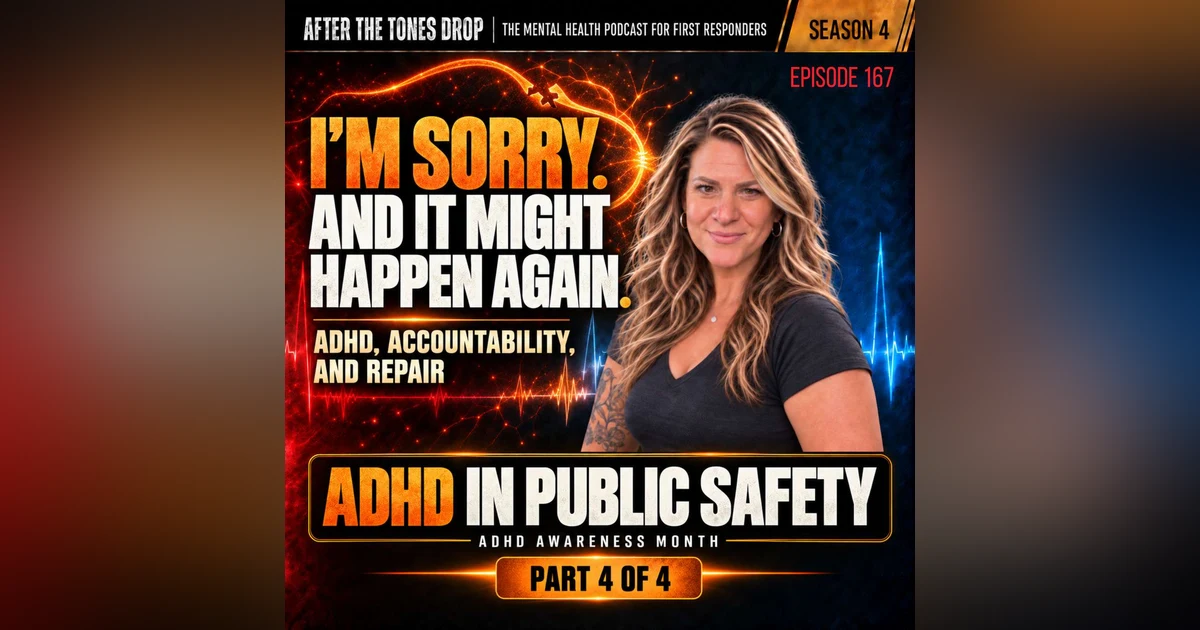

Send us Fan Mail What if the apology is sincere.....and the behavior happens again? “You forgot again.” “You interrupted again.” “You said you’d handle it, and now I’m handling it again.” When the same problem keeps coming back, “I’m sorry” can become hard to believe. But a legitimate explanation, a sincere apology, real harm, and a recurring behavior can all exist at the same time. What does accountability look like then? In the final episode of our four-part series on ADHD in public safety,...
What if the apology is sincere.....and the behavior happens again?
“You forgot again.” “You interrupted again.” “You said you’d handle it, and now I’m handling it again.” When the same problem keeps coming back, “I’m sorry” can become hard to believe. But a legitimate explanation, a sincere apology, real harm, and a recurring behavior can all exist at the same time. What does accountability look like then?
In the final episode of our four-part series on ADHD in public safety, Cinnamon explores what comes after we understand the reason and hear the apology. From forgotten dinners and school forms to interruptions and late arrivals, she looks at how to acknowledge the impact, make a repair, and build support that helps intentions turn into action.
This conversation makes room for the person who is exhausted by their own repeated mistakes and the person who is tired of catching everything that falls. We talk about shame, defensiveness, shared responsibilities, parenting, and boundaries—and why progress needs to be visible and meaningful in the life you share.
In this episode
- Why knowing what to do and reliably doing it can be different challenges.
- What an apology needs beyond “I’ll never do it again.”
- How shame can turn an apology into a request for reassurance.
- Practical supports to test for lateness, interruptions, and forgotten commitments.
- Why a partner cannot automatically become “the keeper of the list.”
- Helping children repair harm while teaching the skills they still need.
- How past experiences shape the meaning we give a familiar argument.
- Recognizing progress while respecting another person’s limits.
Chapters
00:00 — When a sincere apology meets “again”
00:19 — ADHD in public safety: the final conversation
02:36 — An explanation, an apology, real harm, and a recurring behavior
04:36 — The dinner example: responsibility, impact, and trust
06:35 — Moving beyond “I swear it’ll never happen again”
08:06 — Shame, defensiveness, and returning after a pause
10:01 — Building supports that work in everyday life
12:05 — Shared support and “the keeper of the list”
12:29 — Helping children repair while building skills
13:21 — How past experiences shape a familiar argument
15:06 — Boundaries for the person carrying the consequences
16:47 — Recognizing progress and owning what still isn’t working
19:16 — One pattern, one repair, and a concrete plan
20:32 — A more useful apology and a commitment you can keep
Free Companion Resource
Download the complete four-part series companion:
For this installment, spend some time with the section exploring what people see versus what may be happening privately. Visible competence does not always reveal the fear, urgency, exhaustion, overload, or rigid compensation holding it together.
The resource also includes:
- ADHD-associated experiences that may not be fully captured by a diagnostic checklist
- A self-reflection checklist
- Questions for identifying patterns, impact, and support needs
- The Recognition → Beneath the Mask → Accountability → Repair progression
This resource is designed for education and self-reflection. It is not a screening instrument or diagnostic assessment.
Check out our ADHD Traits & Experiences guide here.

Continue the Series
Listen to Part 1: ADHD, Trauma, or the Job?
Listen to Part 2: Same Brain, Different Mask
Listen to Part 3: Hear the Excuse, Find the Reason: Why Accountability Requires Curiosity
Read Up!
Read the Companion Blog for this episode and all episodes in our ADHD series.
Important Note:
This episode and its companion materials are for educational purposes only. They are not intended to diagnose ADHD, PTSD, or any other mental-health condition, and they are not a substitute for individualized assessment or treatment.
ADHD is a neurodevelopmental condition with several recognized presentations. No presentation belongs exclusively to one gender. Trauma, anxiety, depression, autism, sleep deprivation, shift work, substance use, medication effects, learning differences, and medical conditions can create or intensify overlapping experiences.
If these patterns are affecting your work, relationships, health, or daily life, consider speaking with a qualified professional who understands both adult ADHD and trauma.
DISCLAIMER:
After the Tones Drop is shared for educational, informational, and entertainment purposes. It does not provide therapy, medical advice, diagnoses, or treatment, and listening does not create a therapist-client relationship. The views expressed are those of the individual speaking. If you need support, please reach out to a qualified professional or emergency services in a crisis. You can also visit our shows resources page for an abundance of helpful information.
ATTD Music Credits (Music from #Uppbeat):
- Our theme music is Intentions by Abby Noise, licensed through Upbeat
- https://uppbeat.io/t/vens-adams/adventure-is-calling License code: ANJCYVHRMULSNKQR
- https://uppbeat.io/t/vens-adams/rise-of-the-hero License code: H4WTAGJZIXZCM8DM
- https://uppbeat.io/t/yeti-music/homewardLicense code: KO7FZAIJBAEAJLKE
- https://uppbeat.io/t/sonda/the-heart-grows License code: KAID0ITO96GJZAPS
- https://uppbeat.io/t/philip-anderson/achievement License code: XZ4PMCKHW94GUR74
- https://uppbeat.io/t/tobias-voigt/nexus
License code: MVMDRGHKHTJRABVR - https://uppbeat.io/t/paul-yudin/breakthrough
License code: FYPM3OJF0NQ4OGTE
What if the apology is sincere? The reason is legitimate. Everybody understands what we mean. And then the person does it again. I'm Cinnamon, and this is After the Tones Drop. Welcome back to After the Tones Drop. This is our final episode of the four-part series about ADHD in public safety. Today we're talking about something that can make an apology feel almost impossible to believe. Again. That little word can carry years of frustration. You forgot again. You interrupted again. You said you'd handle it, and now I'm handling it again. And somewhere in that conversation, somebody says, if you were really sorry, you wouldn't keep doing it. I understand why people say that. At some point, I'm sorry can start to sound like the thing that someone says to end the argument. So everybody can move on until the next one. But what happens when the person actually means it? What happens when they understand the impact? They hate that they caused it, they genuinely intend to handle it differently in the future, and still struggle to follow through. And that's where we're going today. In Hear the Excuse, Find the Reason last episode, we talked about listening long enough to understand what is driving the behavior and finding where responsibility lives within that explanation. This is the next conversation. We found the reason, we heard the apology. Now what? And because this is part of our ADHD series, we're going to talk about what accountability can look like when remembering, organizing, managing time, or pausing before acting is an ongoing challenge. At home, in our friendships, with our kids, at work, with the people who have heard us say, I'm sorry, enough times that they don't even know what to do with it anymore. If you have ADHD, this conversation includes you too. Your frustration counts. I know for me personally, no one is more frustrated with me than I am when I repeat a behavior that I truly want to stop. And no one can make me feel worse than I can when I do it again and again. An explanation can be legitimate. An apology can be sincere. The harm can still be real and the behavior can still occur. All four things can be true at the same time. Holding all four is uncomfortable. We would love a cleaner answer. Either you couldn't help it, so nobody gets to be upset, or somebody got hurt, so you must not care enough. But when we force everything into those two choices, we lose information that we actually need to change the pattern. ADHD can involve difficulties with attention, organization, remembering daily tasks, managing our time, and inhibiting impulsive behaviors. Those difficulties can affect relationships as well as work. People can experience ADHD differently. A diagnosis doesn't explain every action a person takes, but it can help us understand why certain problems keep showing up. Sometimes somebody knows exactly what needs to happen. They know when they're supposed to leave. Again, you say, I forgot. They say, you always forget when it's something I'm counting on you to do. Now you're talking about dinner, but you're also talking about trust, about who gets to stop thinking about a task once someone else agrees to take it on. You may hear, you're useless. They may hear your time matters less than mine. Neither of those sentences was necessarily spoken out loud, but both can end up driving the argument. And then the explanation comes out. I have ADHD, you know I struggle with this. That information absolutely belongs in the conversation. So does the fact that your partner is now doing something that they thought you would had handled. If you stop at the explanation, you leave them holding dinner and the consequences. If they stop at you don't care, the two of you may never get to the difficulty that you actually need to address to make a change. So try getting specific. I said I would handle dinner and I didn't. You had to step up when you were counting on a break. I understand why you're upset. I'm going to take care of tonight's food. Then I need to look at why the plan never became an action. Notice how much less room there is for arguing about whether or not you're a good person. There is a task, there is an impact, there's something to do next. Your ADHD may help you explain how you got here. Your partner shouldn't have to argue you into recognizing that they were affected. Now let's talk about the promise people often make at the end of the argument. I swear it'll never happen again. Sometimes that promise comes from desperation. You want the person to know how serious you are. You want to stop seeing disappointment on their face. And maybe you want to believe that feeling this bad will finally make the lesson stick. But remorse is a feeling. Remembering to start dinner at five is a task. And tasks need workable plans. If you know something is a reoccurring difficulty, promising permanent disappearance may be more than you can honestly offer. That doesn't mean that you get to shrug and say, well, it might happen again, just deal with it. The title of the episode needs the rest of the conversation. I'm sorry, and it might happen again. I know that matters to you. Here's what I'm changing to reduce the chances. And here is what I will do if I catch it happening again. That is a harder apology to make. You're giving up the dramatic promise. You're also giving up the option of pretending that naming the diagnosis finished the conversation and the work on your part. You're making a commitment somebody can actually observe, and they still may be angry. An apology does not require them to be comfortable on your schedule. And if you are the person with ADHD, I want to stay with you for a minute. Maybe you have heard careless so often that someone pointing out a missed task feels like they're reading your entire life back to you. They're upset about this afternoon, but you are suddenly defending yourself against every teacher, every parent, every supervisor or partner who has ever told you that you would do better if you cared. Side note, I am working on an episode about that exact issue. But back to the topic at hand. That is a lot to bring into a conversation about a school form. It may help explain why you get defensive so quickly. It also gives you something to notice. Am I responding to what this person is saying or what I'm afraid this means about me? You can ask for a pause or a timeout. I want to hear you. I'm getting overwhelmed, and I'm starting to defend myself. Can we take 20 minutes and come back to this? But then you got to come back. A pause needs a return. Otherwise, the person who raised the issue is left with another unfinished thing. And watch for the moment that your apology turns into, I'm terrible, I ruin everything, you'd be better off without me. You may feel that shame sincerely, but now the person that you hurt may feel pressured to comfort you before their own hurt has even been heard. You can have those feelings without making them the other person's responsibility to alleviate. Try, I feel awful about this. I'm gonna stay with what happened and hear what it did to you. You don't have to prove you're suffering enough to deserve forgiveness. You do need to leave room for their experience. So what are we building instead of another promise to just try harder? If you keep leaving late, then look at the whole departure. Getting dressed, finding the keys, letting the dog out, walking to the car. Maybe you've planned for the drive and forgotten that it takes time to get into the car and get the garage open. A reminder that says appointment at two may arrive too late to help. Maybe you need a cue to stop what you're doing and begin getting ready. Then you have to find out whether you can actually use that cue. If you dismiss it every time, the plan it's gonna need another look. If you interrupt because you're afraid you'll lose a thought, maybe you write down a few words while the other person finishes. And if you interrupt anyway, repair can start right there. I cut you off, apologies, finish what you were saying. Then listen. Don't ask them to finish while you're visibly waiting for your turn to speak. If dinner keeps disappearing from your awareness, maybe the plan involves a calendar reminder and preparing something earlier, before the afternoon gets away from you. These are examples to test. No particular reminder or routine works for everybody. Oh, life would be so much easier with ADHD if it did. But the useful question is: what support helps me do this under the conditions where I actually struggle? A beautiful plan that only works on your easiest day still needs to work. Some people also need professional help with managing their ADHD. Seeking support can be part of taking responsibility. So can saying honestly that a strategy that you tried isn't working. But the plan cannot quietly become my partner will remember everything for me. I call this person the keeper of the list. Shared support can be helpful when it is agreed upon. Being assigned the job of monitoring another adult without agreeing to it is a very different experience. If somebody offers a reminder, talk about what that means. One reminder, at what time? What happens next? And if the person with ADHD is a child, the adult's role is different. Kids need support that fits their age and their abilities. We cannot hand them an adult-sized responsibility and then treat the struggle as a character flaw. We can help a child repair while we help build the skill. You forgot to put the materials away, and now your sister can't use the table. Let's clear it together, then let's figure out how to help you remember when you finish. The child still participates and the adult still teaches. And when we are the parent who forgot or interrupted, well, our kids deserve an apology too. I interrupted you. I'm sorry. I want to hear the rest. Go ahead. They don't need to reassure us that we're a good parent before they finish their story. This is also where I think about the predictive model that I work to develop this summer. Our past experiences influence what we predict will happen next. An event happens, we perceive it, we give it meaning, we feel something, we have an urge to act, and then we actually act, and then we live with the result. That is a way to determine a moment. It isn't a diagnostic test for ADHD, but it can help us slow down a familiar argument. Your partner says, you forgot again. Your past experience supplies a prediction. Here comes the lecture. You hear judgment, you give it meaning. They think I'm incompetent. Now you feel ashamed and angry. Your urge is to defend yourself. You start explaining before they finish. The result is that they feel unheard, you feel attacked, and the original problem is still sitting there. Curiosity gives us a place to interrupt that sequence. What did they actually say? What messaging did I add to it? What are they asking me to recognize? And later, when we look at the task itself, where did my intention stop turning into action? Did I never record the commitment? Did I notice the reminder and ignore it? Did I agree to something I didn't realistically have room in my schedule to do? Those are different problems that need different responses. Why am I such an asshole? Doesn't tell you which one happened. Now, for the person on the receiving end, you can understand all of this and still be exhausted. You can believe the apology and still think, I can't keep being the person who catches everything that falls. And you're allowed to say that. Life as a safety net is exhausting. I believe you didn't mean to hurt me and I need this to change, can belong in the same conversation. So can I accept your apology and I need a different boundary now? Maybe you stop waiting indefinitely for someone who is late. I'll wait 15 minutes. After that, I'll leave and we can arrange another time. Maybe you change how a shared responsibility is handled because the current arrangement keeps creating consequences you can't absorb. A boundary needs to fit the actual situation. It should be something that you can follow through on rather than a threat you make at the height of an argument. And you don't have to establish malicious intent before deciding that a pattern is unsustainable. Someone can love you and still be unable or unwilling to participate in the relationship in a way that you can live with. Also, keep the behavior itself in view. Forgetting a task and repeatedly intimidating someone are different situations. Having ADHD does not mean every harmful action is an ADHD symptom. The seriousness of the impact has to factor in. You do not have to keep offering another chance simply because the explanation makes sense. So how do we know whether anything is changing? We need to look beyond whether it ever happened again. Is it happening less often? When it happens, does the person notice sooner? Are they using the support they agreed to try? Does repair happen without the other person having to drag it out of them? Those questions give us more information than another mistake and nothing's changed. But progress also has to matter in the life you're sharing. I tell clients all the time to assume that a behavior change is going to take a while. First, you may never remember what we talked about at the crucial moment that it would serve you. Then you may remember after that crucial moment has passed. Then you may remember, but you're too angry to change the trajectory. Then you may actually start catching yourself midway. Then you intentionally, if not awkwardly, do something different. And then eventually in the future, you may do it naturally or changing a behavior, not hoping it into existence. And change is hard. Something can be improving and still be too disruptive for the other person. They're allowed to need more than the improvement currently provides. And if you have ADHD, your effort can be real even when somebody has reached their limit. That's painful. It doesn't make your effort imaginary. It does mean that their boundary deserves respect. If the behavior shows up again, get specific before deciding what the recurrence proves. Maybe the support wasn't available when it was needed. Maybe the plan depended on remembering to use the plan. Maybe you stopped doing something that was helping. Or maybe you agreed in the moment because you wanted the argument to end and never followed through. That last one needs to be owned too. I agreed to set that up and I didn't. I understand why another promise isn't going to reassure you. Accountability includes being honest about what you did. And the person affected does not have to become the investigator who figures it out for you. Think about one pattern in your own life, something you keep apologizing for, or something someone keeps apologizing to you for. Stay with that one specific event. What happens? Who carries the consequence? What would a repair look like now? Then look at the next time the situation is likely to come up. What will be different before the moment arrives? If the only answer is I'll feel worse if I do it again, we probably need a better plan. If the answer is they need to understand me better, there may still be a responsibility you haven't picked up. And if you're the person receiving the apology, you can ask for something concrete without demanding a guarantee nobody can honestly make. What are you putting in place? What can I expect if it happens again? What part of this are you asking me to help you with? And what part are you taking care of? You may find a workable agreement. You may discover that you need a firmer boundary. Either way, you have more to work with than another round of you don't care and you don't understand. I'm sorry and it might happen again. When the period is there, that sentence can sound frightening. So don't end it there. I'm sorry and it might happen again. I understand that this affected you. I'm working on the part that I can influence. Here's what I'm changing. If the pattern shows up again, I will own it and look at what failed. I won't ask you to pretend that it didn't matter. And leave room for the other person's answer. They may need time. They may need evidence. They may need a boundary you wish they didn't. If we're going to be honest about our own limits, we have to let others be honest about theirs. You can stop promising a version of yourself who will never struggle with this again. You can make a more useful commitment today. A reason helps us understand the pattern. Responsibility is what we do with that understanding. That's all I have this week. Take care of yourself and be safe out there. After the tones drop is shared for educational, informational, and entertainment purposes. It does not provide therapy, medical advice, diagnoses, or treatment, and listening does not create a therapist-client relationship. The views expressed are those of the individual speaking. If you need support, please reach out to a qualified professional or emergency services in a crisis. Our theme music is intentioned by Abby Noise, licensed through update.